How to Choose the Best Glue for Wood
First Published October 3, 2024
Wood is highly durable, easy to maintain, and easy to work with. Which undoubtedly makes it one of our most useful and sustainable building materials. That being said, whatever you’re creating from wood, most projects often call for the use of wood glue. But what’s the best wood glue for the job?
In this article we will show you how to choose the best glue for wood. We’ll answer questions like how long does it take for wood glues to set? And explain how different types of glue offer contrasting performance to suit the distinct needs of your woodworking project.
What to Consider When Choosing the Best Wood Glue
No matter what you’re creating from wood, the adhesive will almost always be one of the most important components of any project. That’s because a well chosen adhesive not only binds pieces of wood effectively, but also provides resistance to external factors.

Beads of white PVA wood glue
Key Attributes of Wood Adhesive
Things like moisture, temperature variations, and stress always contribute to the longevity of an assembled woodworking project. So taking a moment to consider the performance characterisics of your glue before getting started, will certainly save you time and money in the long run.
Lets take a closer look at the key things that you should consider before buying your wood glue:
Wood Glue Strength
Bond strength is created after the glue has dried and its one of the most important factors to consider. That’s because some glues create stronger bonds than others, which in some cases can be stronger than the wood itself. So always make sure that the glue you choose is strong enough to withstand the rigours of your projects intended usefulness. After all what use is a chair that can’t bear weight!
Viscosity, Thickness and Gap Filling Ability
Viscosity is the property of a given liquid that describes its resistance to flow. A highly viscous fluid tends to be thick, like honey. Compared to a relatively nonviscous fluid, such as water, highly viscous liquids flow much more slowly.
Drying Time
Having things dry quickly is often the best all round result. However when it comes to joining wood, short working times can sometimes be a hinderence. On certain types of assembly project the short working time of some glues can make sliding a tenon up or down in its mortise virtually impossible after just two or three minutes. This can lead to a huge amount of stress and can result in misaligned joints after the glue has dried. Therefore being prepared to wait 24 hours for something to dry is sometimes preferable.
Water Resistance
A huge factor in the strength and durability of glue joints is location. Will the joints of your project be regularly exposed to the elements, such as humidity, rain or snow? If so, you will need to choose an approriate adhesive, one that is designed to endure moisture.
Temperature Resistance
Most wood glues have a specific temperature range within which they cure optimally. If they are used in environments outside this range, then molecules can not bond effectively with the fibers of wood. Unfortunately this can lead to joint failure.
Additionally if the chosen glue is not temperature-resistant to its enviroment, then over time it may become brittle when exposed to repeated temperature changes. Furthermore, considering that wood is hygroscopic, meaning it absorbs and releases moisture from its surrounding environment, causing it to expand and contract. In situations like this, if the glue in use has become brittle, then joint failure is inevitable.
Cost
Naturally the cost of materials is always important. Unsurprisingly in the world of wood glues, adhesive products which dry faster and are more durable, tend to be more expensive. However considering everything in the paragraphs above, the most expensive glues are not always the most appropriate for a given woodworking project. Therefore when selecting your glue, always consider cost last, doing this will possibly help you save money.
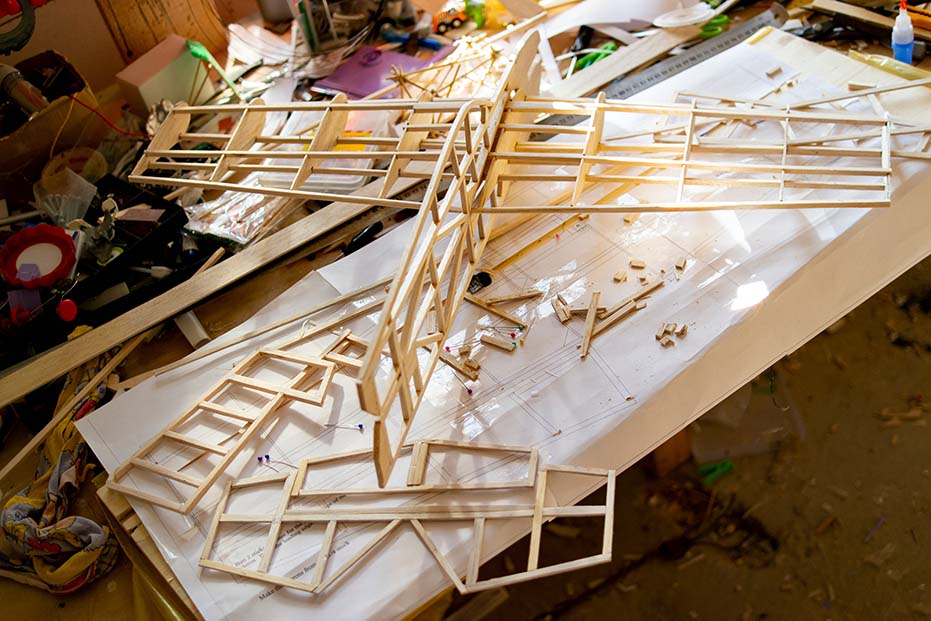
Some wood glues are more durable than others
European Standards for Wood Glue Durability
The European standard which governs the classification of the best wood glues for non-structural applications is known as BS EN 204. As part of this standard there are 4 classifications for durability, which run from D1 to D4.
As you might expect ‘D’ stands for durability. Addtionally the accompanying number can be used to indicate a level of water resistance.
Most good wood glue manufactures will aways speciify which stress standard their product meets. So here is a brief explaination of the differences between each testing standard:
D1 Wood Glues
These must be able to maintain their bond strength in indoor areas. Where the temperature only occasionally exceeds 50°C for a short time and moisture content in the wood does not exceed 15%.
D2 Wood Glues
These must be able to maintain a good bond strength in indoor areas. Where there is occasional short term exposure to running or condensed water, as well as occasional high humidity. Provided that the moisture content of the wood does not exceed 18%
D3 Wood Glues
These must be able to maintain a good bond strength in indoor and outdoor areas. Where indoors there is frequent short term exposure to running or condensed water, as well as heavy exposure to high humidity. Provided that outdoor areas are not exposed to weather.
D4 Wood Glues
These must be able to maintain a good bond strength in indoor and outdoor areas. Where there is frequent long term exposure to running or condensed water, as well as heavy exposure to high humidity.
Different Types of Glue for Wood
When it comes to choosing the best wood glue there are many types to choose from and the best wood glue for your particular job might not be the strongest or most expensive. Some wood glues employ old formulas that have been around for decades, while others take advantage of newer technologies. So depending on the project, every type of glue can be useful.
PVA Wood Glue
Polyvinyl acetate (PVA) is the most common and trusted type of wood glue. This water soluble adhesive is is easy to use and comes in several different variants, including water resistant.
Project location is a good way to determine the best varient to use. Ask yourself is my project going to be exposed to high levels of moisture? PVA sets well with good air circulation, and dries fastest at room temperature.
Benefits of PVA Wood Glues
-
- Low cost: Generally the least expensive wood glue with performance on par with other types of glue at a much higher price points.
- Moderate setting: Easy to use with a modest tack, so you benefit from adequate time to make slight adjustments before it sets.
- Good bond strength: When dry its generally stronger than wood, but not quite as strong as other types of wood glues.
- Water resistant: Certain types of PVA glue offer good levels of water resistance.
- Non-toxic: PVA is completely safe for closed environments without ventilation.
Things to Consider About PVA Wood Glues
-
- Low material compatibility: Only suitable for porous materials like wood.
- Poor stain absorption: Does not absorb stain in the same way as wood, so any excess surface glue will still be visible if the wood is stained.
- Poor low temperature resistance: Temperatures well below freezing can cause the polymer bonds to freeze and break.
- Environment degradation: PVA will not degrade on its own, but it can be affected by certain environments.
Polyurethane Wood Glue
Polyurethane (PU) glue, is a synthetic plastic resin. This popular wood adhesive has several properties which make it unique compared to others. These include a foaming action which makes it expand as it dries.
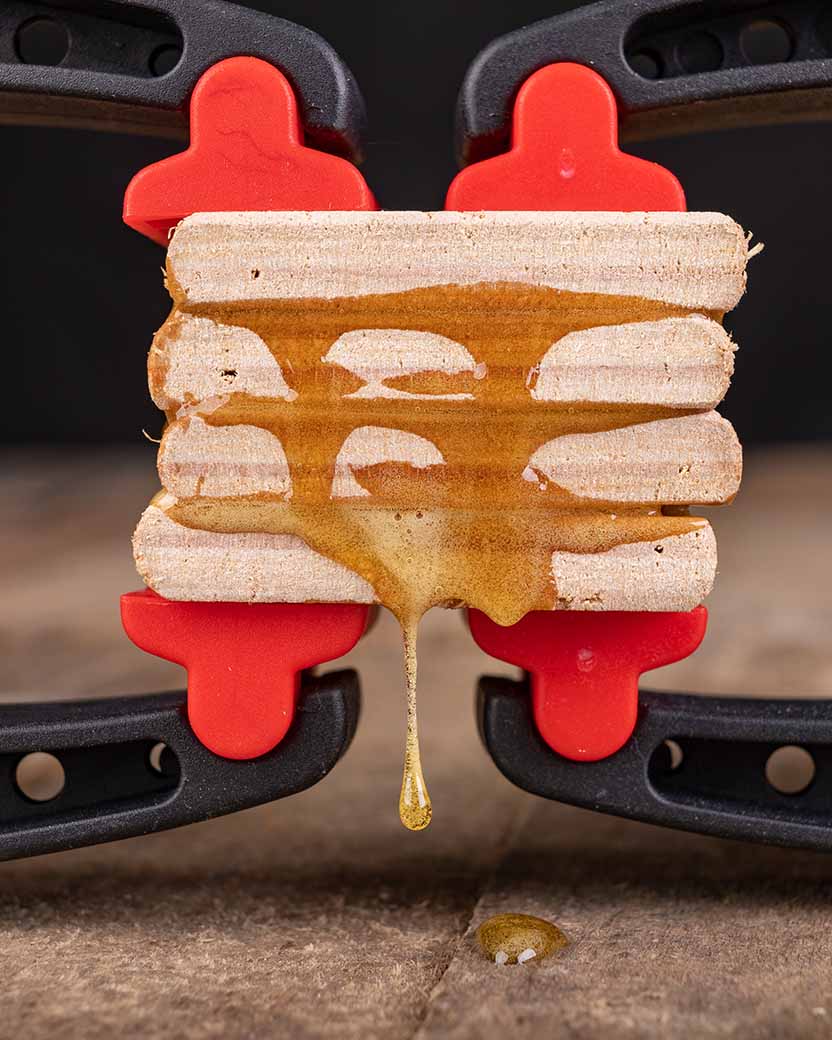
Always use clamps with polyurethane wood glues
Polyurethane wood glue requires moisture to cure and while doing so it expands to fill gaps. This makes it an ideal choice for making wood joints with end grain. This is because, unlike other types of wood glue, it can penetrate wood grain fibres to create much stronger bonds.
Benefits of Polyurethane Wood Glues
-
- High material compatibility: Can adhere to most smooth substances like metal and glass.
- Fast setting: Short open working times mean you can work quickly to assemble your project once you’ve applied it.
- Expansion: Foams and expands while curing, which helps fill uneven gaps in joints.
- Low moisture content: Less likely to make wood fibres swell.
- High bond strength: Stronger than PVA glue and great for end grain joints.
- Waterproof: This type of glue can be used in wet environments with zero loss of strength.
- Great temperature resistance: Bonds remain undamaged when exposed to extreme temperatures for prolonged periods of time.
Things to Consider About Polyurethane Wood Glues
-
- Toxic: Releases fumes as it cures which can be dangerous if inhaled.
- Clamping recomended: Because the glue expands as it dries it can push pieces apart.
- Difficult to use: Can be messy, so always wear gloves and clean up quickly.
- Cost: More expensive than PVA but less than cynoacrylate and epoxy glues.
Cyanoacrylate Wood Glue
Often referred to as “super glue”, cyanoacrylate (CA) is an acrylic resin that forms bonds almost instantly. Thanks to speedy curing its often used for small, quick repairs, such as fixing chipped or cracked wood.
Loctite Super Glue
Liquid cyanoacrylate glues generally have very low viscocity. However they also come as higher viscocity gels, which makes them easier to use with wood.
CA glues stick to most materials because of their moisture curing process. They begin setting when exposed to moisture, and since there is moisture almost everywhere, tend work well with almost any surface.
Benefits of Cyanoacrylate Wood Glues
-
- Very fast setting: CA glues deliver almost instant bonds, which means that you can work quickly.
- High material compatibility: Can adhere to a variety of porous and non-porous surfaces like wood, rubber, leather, metals and glass.
- Very high tensile strength: This type of glue is often used in conjunction with other wood glues to provide temporary clamping assistance.
- Good water resistance: Once completely dry CA glues create bonds that are impermeable to water, but they are not suitable for extended exposure.
Things to Consider About Cyanoacrylate Wood Glues
-
- Cost: More expensive than PVA and polyurethane wood glues, so not suitable for glueing large projects
- Low sheer strength: Bonds have poor impact resitance and can be broken by lateral knocks and jolts.
- More difficult to use: Will bond skin to skin in seconds. Fast setting time can be unforgiving if any changes need to be made.
Epoxy Wood Glue
This type of glue normally comes in a two part formula, consisting of a resin and a hardener. When combined a chemical reaction takes place to begin the curing process, which can be very fast.
Unlike the liquidity of other wood glues, epoxies thicken into a dough like consistency, which makes them great for filling and repairing damaged joints.
Once dry the high durability and waterproof qualities of epoxies often make it the preffered choice for high performance applications. For instance, they’re often used for joining wood in boats and sailing vessels.
Pros of Epoxy Wood Glues
-
- Very high bond strength: Once mixed and cured, epoxies are some of the strongest glues available. Some are even known to be harder than steel.
- Very fast setting: Cure times can vary but for most it is conveniently short, which means that you can work quickly.
- Fill gaps: Epoxy glue is a good choice if your joint needs a little filling, you can also mix sawdust into the mixture.
- Waterproof: Always check packaging but most can even bond and cure underwater.
Things to Consider About Epoxy Wood Glues
-
- Cost: Often the most expensive type of wood glue.
- Acidic wood: Some woods are harder to glue using epoxies. Oak is a good example of an acidic wood that may be difficult to bond using an epoxy glue.
- More difficult to use: Epoxy glues often come with an activator component and require mixing before use. Plus fast setting times can be unforgiving if any changes need to be made.
- Toxic: Be sure to use in a well-ventilated area and always wear gloves.
Hide Glue
Hide glue is one of the oldest known bonding agents and has been used to glue wood for centuries. As the name implies, it’s made from animal hide.
Some hide glues need to be heated before you use them, but others are available in liquid form, which means they can be applied straight from a bottle.
This type of glue is popular with traditional furniture makers and antique repairers who often regard it as the best wood glue for furniture. This is because it can be easily loosened by warming. Therefore it is really forgiving and easy to work with, since components can be adjusted as needed.
Benefits of Hide Wood Glues
-
- Slow setting: This glue is easy to use and has a longer open time than other wood glues.
- Excellent stain absorption: Unlike other wood adhesives hide glue will accept stains and finishes whilst remaining unnoticed.
- Easily reversible: When dry this tyoe of glue can be re-loosened with gentle heat and then manipulated as needed.
- Very low moisture content: Will not make wood fibres swell and can also act as a slight lubricant which makes creating tight joints easier.
- Non-toxic: Does not contain VOCs and is safe for closed environments without ventilation.
Things to Consider About Hide Wood Glues
-
- Animal based product: Not vegan friendly.
- Medium bond strength: Hide glue joints can break more easily on shock impact.
- Not water resistant: Do not use hide glue if your project is located around high humidity or regaulry comes into contact with water.
- Strange smell: Hide glue discharges a harmless odour, however this normally goes away after glue joints are completely dry.
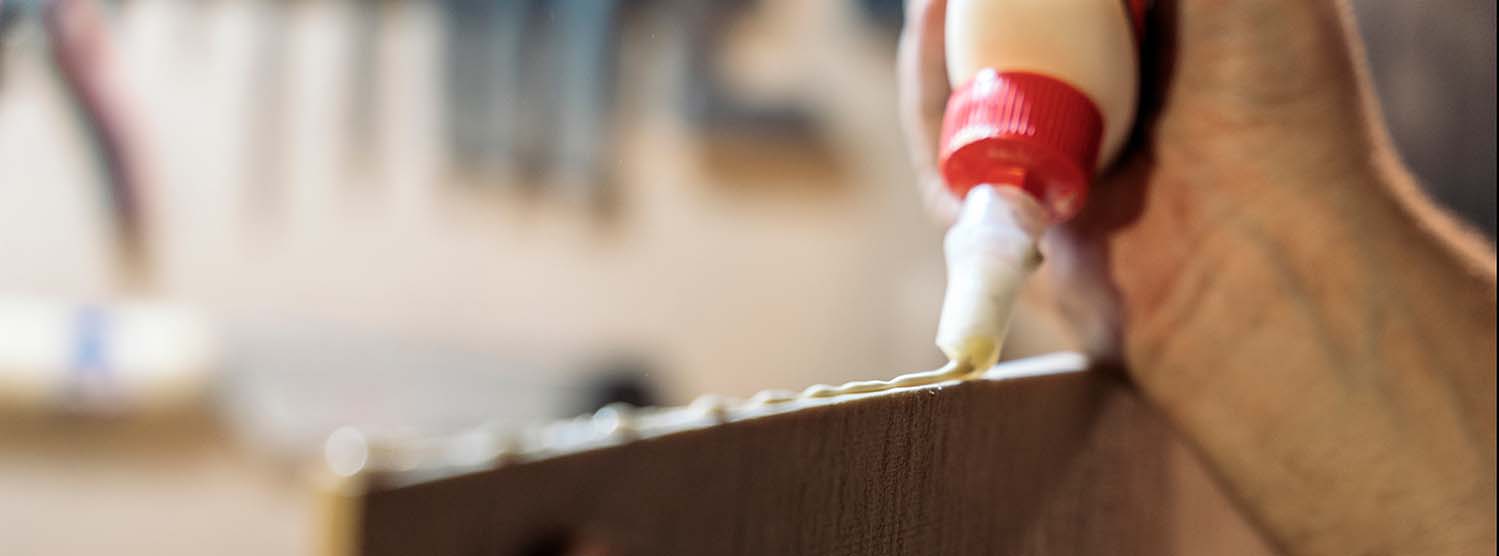
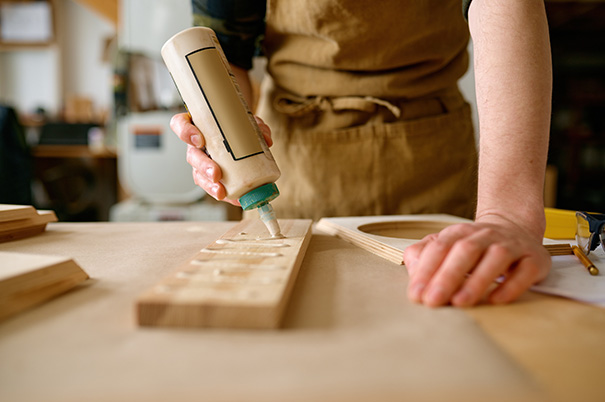
Precisely applying PVA wood glue using a bottle
So Which is the Best Glue for Wood?
The truth is that there is no one size fits all answer to the question of which is the best glue for wood. This is because different types of wood glue are made to specialise in different applications.
So, based on your own application and budget, remember to always choose a glue that offers you the best combination of strength and durability.
Every type of wood adhesive mentioned above will be strong enough for normal indoor woodwork, like furniture assembly or repairing broken wood. But in most cases using a basic PVA glue will often get the job done.
However if your project is going to be located in an outdoor environment or exposed to demanding everyday use, then it’s always best to check and choose a D3 or D4 wood glue to best meet those specific conditions.